Mermaid Spells: Sea Alchemy, Seiðr & the Goddess Mysteries of the Deep – Helena B. Scott – Zoom

Mermaid Spells: Sea Alchemy, Seiðr & the Goddess Mysteries of the Deep

Mermaids are archetypal initiators of transformation; liminal beings of sea and soul who embody Lady Alchemy, guiding us to unite opposites within and awaken the full, integrated self. As symbols of deep change, they help us reconcile shadow and light, matter and spirit, conscious and unconscious, opening the way to expanded awareness and spiritual renewal.

This rare and original talk invites you into the depths of ancient sea magic through the lens of archetypal and depth psychology. You will explore how the living energies of the ocean awaken intuition, inner magic and the divine feminine, while engaging with historic rituals and practical approaches to working with oceanic currents, ancestral memory, creation and rebirth.

The journey moves through ancient goddess traditions and living practices of sea magic, beginning with Isis—inventor of all things marine, Light bringer as Isis Pharia and known as Our Lady of the Seas,a title she later shares with Mary. From her waters, we descend into Norse oceanic sorcery and the legacy of Freyja, golden-haired goddess of love, war and witchcraft, and the first völva to initiate Odin into seiðr, the art of foresight and fate-weaving. The talk also weaves in sacred knotwork with Mesopotamian, Sámi and Norse roots, alongside the modern Blue Mind concept, revealing water as both a mirror of the soul and a powerful force for inner renewal and transformation.

Are you ready to answer the call of the deep? Book your place on this unique ocean-themed talk now and step into the tide of transformation.

Speaker Bio:

Helena B. Scott is a Jungian writer, linguist, historian, and cultural heritage specialist whose work in historical revisionism bridges medieval history, esoteric symbolism, and depth/archetypal psychology through a multidisciplinary lens. She specialises in the Knights Templar, the Grail tradition, and the sacred feminine, with research exploring spiritual alchemy, symbolism, and ancestral archetypes—particularly mermaids, Mary Magdalene, and sacred feminine mysteries preserved within Gnostic andesoteric medieval European traditions.

She was recently awarded an MA (Hons) in Public History & Cultural Heritage (2025) by the University of Limerick, following an MA internship with Waterford Medieval Museum, and in 2009 her work played a pivotal role in a UNESCO campaign that successfully declared falconry as intangible cultural heritage. Helena has also undertaken extensive training in Depth and Archetypal Psychology, including with Laurence Hillman, son of US psychiatrist James Hillman, the founder of Archetypal Psychology, and holds several diplomas from the Jung Centre (Dublin), including a Diploma in Jungian Psychology.

In October 2025, Helena founded Ireland’s first public Templar history festival, Waterford Templar Historical Day, developed as part of her MA research and framed under the UNESCO Historic Urban

Curated & Hosted By:

Lena Schattenherz Heide-Brennand is a Norwegian lecturer with a master degree in language, culture and literature from the University of Oslo and Linnaeus University. She has been lecturing and teaching various subjects since 1998. Her field of interest and main focus has always been topics that others have considered strange, eccentric and eerie, and she has specialised in a variety of dark subjects linked to folklore, mythology and Victorian traditions and medicine. Her students often point out her thorough knowledge about the subjects she is teaching, in addition to her charismatic appearance. She refers to herself as a performance lecturer and always gives her audience an outstanding experience

don’t worry if you miss it – we will send you a recording valid for two weeks the next day
Into the Faerie Rings: Psychedelic Plant Medicines and Faerie Realms – Zina Brown – Zoom

Into the Faerie Rings: Psychedelic Plant Medicines and Faerie Realms

Are you… curious?

Many a traveller in folklore and fable have come across the Faerie Rings – magical circles of mushrooms that can transport the curious (willing or not) to the faerie realms. They may find themselves lost in bizarre lands of pure imagination, colorful as they are confusing, populated by unusual beings both benevolent and malevolent, time stretching impossibly around them.

Catch a bit of faerie sight? To those that have journeyed with psychedelics – it may sound familiar!

In this lively lecture, we’ll explore the wild and wondrous connections between the unseen realms of faerie, nymphs, and hidden folk with the strange and powerful experiences from visionary plant and fungi medicines – such as Ayahuasca and Psychedelic Mushrooms.

Told from a shamanic storyteller’s perspective, we’ll dive into the unseen worlds waiting all around us. We’ll remember the old ways of connecting with nature spirits are as needed today as they ever were. And we’ll learn that curiosity goes both ways – they are as curious about us as we are about them.

Will you step inside… and see what awaits?

Speaker Bio:

Zina Brown is the writer and director of “The Faerie Rings”, an upcoming narrative feature film about the promise of visionary plant medicines, and the cruelty of those who would outlaw them. Zina’s unique visual and narrative style has been awarded in film festivals across the world, including the Barcelona International Environmental Film Festival, Kyiv Film Festival in Ukraine, Mexico City International Film Festival, Amsterdam International Film Festival, San Antonio Film Festival, and the Woods Hole Film Festival. He has over 25 years of writing and directing experience, including numerous music videos and festival favorite short films. His short film, Dreams of the Last Butterflies, was screened at 50 Film Festivals in 13 countries, as well as winning many awards. www.thefaerierings.com

Curated & Hosted By:

Lena Schattenherz Heide-Brennand is a Norwegian lecturer with a master degree in language, culture and literature from the University of Oslo and Linnaeus University. She has been lecturing and teaching various subjects since 1998. Her field of interest and main focus has always been topics that others have considered strange, eccentric and eerie, and she has specialised in a variety of dark subjects linked to folklore, mythology and Victorian traditions and medicine. Her students often point out her thorough knowledge about the subjects she is teaching, in addition to her charismatic appearance. She refers to herself as a performance lecturer and always gives her audience an outstanding experience

don’t worry if you miss it – we will send you a recording valid for two weeks the next day

Chilling Encounters with the Islamic Jinn – Mahdi Jannatdoost – Zoom

Chilling Encounters with the Islamic Jinn – Mahdi Jannatdoost

Invisible, ancient, and deeply unsettling, the jinn occupy a shadowy realm alongside humanity—watching, whispering, intervening. Neither angels nor demons, they are beings of smokeless fire: capable of belief or disbelief, kindness or cruelty, love or vengeance.

In this eerie lecture, we descend into the Islamic world of jinn as described in the Qur’an, Hadith, and centuries of folklore, theology, and lived experience. We explore chilling encounters recorded by scholars and storytellers alike: possession and obsession, jinn marriages, desert hauntings, whispers at night, and the dangerous consequences of crossing unseen boundaries.

What happens when humans accidentally insult a jinn? Why are ruins, crossroads, bathrooms, and wilderness places of fear? Can jinn fall in love with humans—or seek revenge? And how do exorcism, protection rituals, and Qur’anic recitation function in real Islamic practice today?

Blending theology, anthropology, folklore, and spine-tingling case stories, this talk reveals a spirit world that is not metaphorical—but real, moral, and terrifyingly close.

This is not a fantasy of demons and monsters.

This is a belief system lived by millions—where the unseen may already be listening.

Enter respectfully. Leave cautiously.

Speaker Bio:

Mahdi Jannatdoost is an Iranian-born engineer with a Master Degree in civil engineering currently based in Norway, where he works within the field of sustainable construction and engineering. With an academic background in civil engineering and green energy technologies, his professional training is rooted in material science, structural systems, and applied research- a background that should surely make him a true sceptic of anything paranormal.

However- Alongside his formal career, Mahdi has maintained a long-standing and deeply personal interest in Islamic folklore, occult sciences, and the study of non-human intelligences as understood within Islamic cosmology. In particular, he has spent years researching the nature of jinn—beings described in the Qur’an and classical Islamic literature as intelligent entities formed from smokeless fire, existing alongside humanity in an unseen realm. Drawing on traditional sources, folklore, and lived belief, Mahdi approaches the subject not as fantasy but as a meaningful and culturally embedded worldview held by millions across the Islamic world. His interest is further informed by personal experiences which he understands as encounters with jinn—experiences that have shaped his research questions and his desire to engage openly with the topic.

Through lectures and discussions, Mahdi seeks to present both scholarly perspectives and first-hand reflections, offering audiences a rare insight into how belief, experience, and tradition intersect in contemporary understandings of the jinn.

Curated & Hosted By:

Lena Schattenherz Heide-Brennand is a Norwegian lecturer with a master degree in language, culture and literature from the University of Oslo and Linnaeus University. She has been lecturing and teaching various subjects since 1998. Her field of interest and main focus has always been topics that others have considered strange, eccentric and eerie, and she has specialised in a variety of dark subjects linked to folklore, mythology and Victorian traditions and medicine. Her students often point out her thorough knowledge about the subjects she is teaching, in addition to her charismatic appearance. She refers to herself as a performance lecturer and always gives her audience an outstanding experience

don’t worry if you miss it – we will send you a recording valid for two weeks the next day

Undertakers and Death with Dr Dan O’Brien LIVE

Please note this is NOT a ZOOM Lecture but an in person lecture. Tickets include a complimentary glass of Devil’s Botany Chocolate Absinthe. Doors open at 6:30pm and talk starts at 7pm

Undertakers and Death: A Merry Dance with Dr Dan O’Brien

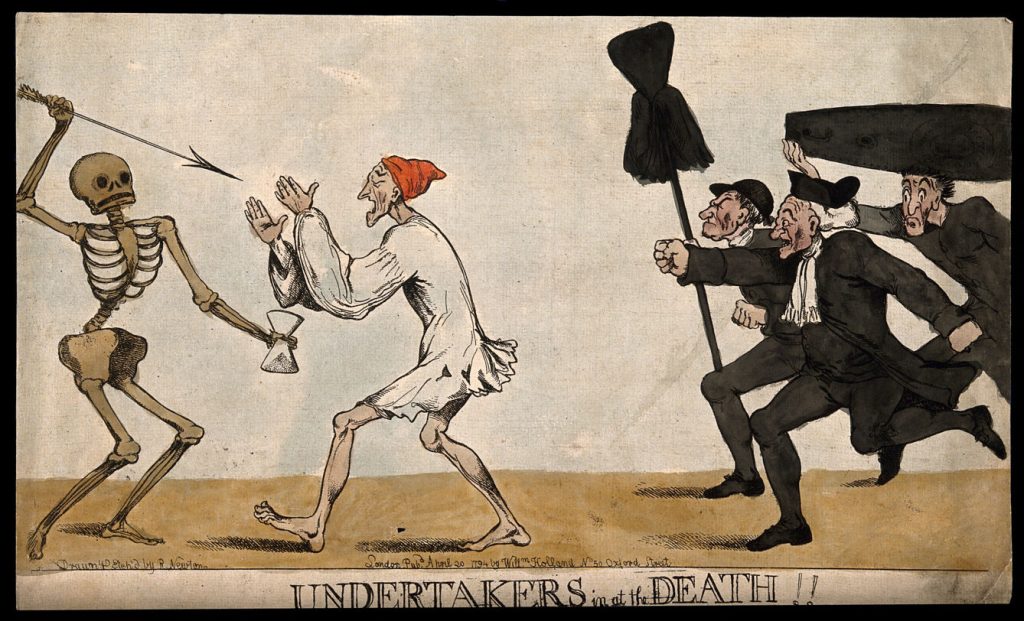
Join us at The Last Tuesday Society for an illustrated talk with Dr Dan O’Brien exploring the imagined world of the early undertaker and some of the most striking depictions of the undertakers’ relationship with death. Death historian Dr Dan O’Brien describes how the fortunes and misfortunes of the undertaker were window on popular ideas about death and the new trade that benefited from it.

An eighteenth-century cartoon imagined a dainty dance between Death and undertaker; the sable-clad death worker was amusingly uncomfortable with his scowling partner. In this busy century, the relationship between undertakers and death was imagined as an uneasy alliance. The early trade’s dependence on death was often caricatured with the gloomy undertaker joined by the familiar skeleton of the memento mori. Death brought joy to the undertaker but this mortal fellow was not invulnerable to its approach and nor could rely upon inevitability of death.

Dr Dan O’Brien

Death historian Dr Dan O’Brien is a Visiting Research Fellow at the Centre for Death and Society, University of Bath. Dan’s research primarily focuses on the development of the undertaking trade and its products in the eighteenth century. He seeks to understand how the undertakers and their goods were perceived by society, by analysing how funerals were presented in the popular culture of the period. Drawing upon an eclectic range of source materials has enabled him to consider simple, but often overlooked, questions about how people’s knowledge about the early trade was formed. His research has produced four chapters, two of which are now published with Routledge and University of Bristol Press. Dan also talks publicly to a wide range of audiences on different themes in mortality history such as funerary gifts, sea burial and mourning jewellery. He has recently appeared on History Hit’s After Dark podcast talking about the funeral of Queen Victoria and describing a funerary crime on Killing Time with Rebecca Rideal.

Dr Dan O’Brien Social Media Links:
TikTok : tiktok.com/@dr.dan.o
Instagram: Instagram.com/dr.dan.o
Bluesky: https://bsky.app/profile/drdan.bsky.social

—————————————-

The Absinthe Parlour at The Last Tuesday Society is London’s best award-winning alternative cocktail bar hidden within The Viktor Wynd Museum of Curiosities. A drinker’s cabinet of wonder filled curious cocktails & extraordinary elixirs —The Last Tuesday Society’s Absinthe Parlour is truly a hidden treasure of East London. Opened by collectors, drinks historians & absinthe experts — Allison Crawbuck (Brooklyn) & Rhys Everett (London) in 2016, the duo bring with them a shared passion for the mysterious world of spirits & the macabre.

—————————————-

Devil’s Botany is the UK’s first absinthe distillery, founded by Directors of The Last Tuesday Society’s Absinthe Parlour. Celebrating spirit’s connection to art, literature, magic & mixology, Devil’s Botany is unleashing the future of absinthe with bold expressions for the adventurous drinkers of today.

The venue opens at 18:30. Doors will close at 19:00 to avoid disrupting the speaker. We kindly ask that all guests arrive before 19:00. Refunds are not possible for in person events with less than seven days notice in any circumstances.

Death and Undertaker

Nocturnes, Symphonies & Seances: Whistler’s Life & Art—Antony Clayton (Zoom)

Painter, printmaker, teacher, critic, polemicist, flamboyant dandy, acerbic wit, ebullient self-publicist, irascible litigant and a serious artist of considerable refinement, James McNeill Whistler (1834–1903) was one of the most controversial figures in the London art world of the late-Victorian period. This talk coincides with the first major European retrospective of Whistler’s work in 30 years, which is on at Tate Britain from 21 May to 27 September.

Educated in the Parisian studio of Charles Gleyre and influenced by Japanese art and design, Whistler spent many of his most productive years in Chelsea, capturing crepuscular atmospheric effects on the Thames and producing some of his most memorable portraits. His distinctive Nocturnes, Arrangements, Symphonies and Harmonies verged on abstraction and challenged the orthodox Victorian belief in the primacy of subject matter, so much so, that John Ruskin famously accused him of, “flinging a pot of paint in the public’s face”. Many writers of the time, such as Baudelaire, Mallarmé, Verlaine, Swinburne and Oscar Wilde, were fascinated by his work, although he often fell out with friends and admirers.

This talk will outline Whistler’s life and work and also address his interest in Spiritualism and similar phenomena such as séances, spirit rapping, table turning and mesmerism. Having once ‘talked’ to a dead American cousin, Whistler wished to communicate with long-dead painters in the hope of learning their secrets, using his muse and lover Joanna Hiffernan as a medium.

About the Speaker

Antony Clayton is the author of Subterranean City: Beneath the Streets of London (2000), London’s Coffee Houses, a Stimulating Story (2003), Decadent London (2005), The Folklore of London (2008) and Secret Tunnels of England, Folklore & Fact (2015). He also co-edited (with Phil Baker) and contributed to Lord of Strange Deaths: the Fiendish World of Sax Rohmer (2015) and wrote Netherwood: Last Resort of Aleister Crowley (2012), which also featured contributions from David Tibet, Gary Lachman and Andy Sharp. His latest book is Mansion of Gloom: the Unsettling Legacy of Poe’s ‘The Fall of the House of Usher’ (Accumulator Press, 2024). This is the third talk Antony has given for the Viktor Wynd Museum.

Your curator and host for this event will be the author Edward Parnell, author of Ghostland: In Search of a Haunted Country. Ghostland (William Collins, 2019), a work of narrative non-fiction, is a moving exploration of what has haunted our writers and artists – as well as the author’s own haunted past; it was shortlisted for the PEN Ackerley 2020 prize, an award given to a literary autobiography of excellence. Edward’s first novel The Listeners (2014), won the Rethink New Novels Prize. His latest book is All the Fear of the Fair (pub. Oct 2025) the second antholoigy he’s edited for the British Library’s Tales of the Weird series. For further info see: https://edwardparnell.com

Don’t worry if you can’t make the live event on the night – we will send you a recording valid for two weeks the next day.

[Image: Nocturne: Blue and Gold by James McNeill Whistler. Public domain via Wikimedia Commons.]

Ghost Films: A Seance of Early Cinema with Alex Kirstukas – LIVE

Please note this is NOT a ZOOM Lecture but an in person lecture. Tickets include a complimentary glass of Devil’s Botany Chocolate Absinthe. Doors open at 6:30pm and talk starts at 7pm

Ghost Films: A Seance of Early Cinema

Victorian filmmakers were fascinated by ghosts and the occult; in their jubilant experiments at the birth of cinema, they explored everything from effects for the creation of ghosts, to skits about seances and spiritualists, to speculations about the ‘ghostliness’ of the new medium itself. In our time, with more than 90% of Victorian films presumed lost, how do the ghosts of these filmmakers and films haunt the narratives of film history? How do spectral traces of little-studied figures – the disruptive, the marginalised, the unclassifiable – lurk in the margins of those narratives? Most of all, how does the documentary detritus of the archive provide us with material for research ‘seances’, opportunities for ghostly reconstruction?

Join theatre and film scholar Alex Kirstukas for a lecture that features a selection of surviving early ‘ghost films’ with live commentary, and calls upon Victorian seance practices for an interactive experiment in raising the ghosts of intriguing films now lost.

Devil’s Botany is the UK’s first absinthe distillery, founded by Directors of The Last Tuesday Society’s Absinthe Parlour. Celebrating spirit’s connection to art, literature, magic & mixology, Devil’s Botany is unleashing the future of absinthe with bold expressions for the adventurous drinkers of today. The Last Tuesday Society’s curious Monday night lecture series is sponsored by Devil’s Botany.

The venue opens at 18:30. Doors will close at 19:00 to avoid disrupting the speaker. We kindly ask that all guests arrive before 19:00. Refunds are not possible for in person events with less than seven days notice in any circumstances. Please note, the museum of curiosities is not opened on Mondays during our lectures.

Deathbed Visions: What do we see at the edge of life? – Stuart Gray – Zoom

Deathbed Visions: What do we see at the edge of life?

As the body begins to fail and consciousness loosens its grip, many people report experiences that are anything but ordinary. In the final hours or moments before death, the dying often describe vivid visions: encounters with long-dead loved ones, journeys, presences, lights, messages—scenes that feel emotionally charged, coherent, and deeply real. These are known as deathbed visions.

Drawing on over sixty years of scientific research, we will explore the recurring patterns behind these extraordinary experiences. We will introduce four common categories of deathbed visions and examine the leading naturalistic explanations offered by neuroscience, psychology, and medicine—asking where they succeed, and where they fall short.

From there, we turn to a more provocative question: why has deathbed vision research itself so often been treated as scientifically suspect? When examined closely, attempts to exclude DBVs from legitimate science begin to unravel—revealing uncomfortable fault lines that would also undermine accepted areas of contemporary research.

Rather than a fringe curiosity, deathbed visions emerge as a rich, methodologically serious, and urgently under-examined body of data. The material is already here. The question is whether we are prepared to look at it—and what it might ask us to rethink about consciousness, dying, and the limits of scientific inquiry.

Speaker Bio:

Stuart H. Gray works as a freelance writer and trainer in the technology sector. He has a Bachelor of Science (Honours)degree in Computer Science from the University of Strathclyde, and a Diploma of Higher Education in Theology from the University of Gloucestershire. More recently, he received Highest Honors in both the Master’s Degree in Christian Apologetics and the Master’s in Science and Religion at BIOLA University. His thesis isentitled“Deathbed Visions: The Development of a Christian Apologetic Argument and An Assessment of Naturalistic Counterarguments.” He co-edits the Evangelical Philosophical Society’s Web Project called “Philosophical Issues in ‘Afterlife Apologetics’” with Dr J Steve Miller. He is embarking on a PhD to study deathbed visions amongst Hindu people. He is also currently writing a book assessing common deathbed experiences in the light of secular and non-secular worldview expectations.

Linked-In: https://www.linkedin.com/in/stuarthgray/

EPS Web Project: Philosophical Issues in ‘Afterlife Apologetics’

https://www.epsociety.org/articles/web-project-philosophical-issues-in-afterlife-apologetics/

Curated & Hosted by:

Lena Schattenherz Heide-Brennand is a Norwegian lecturer with a master degree in language, culture and literature from the University of Oslo and Linnaeus University. She has been lecturing and teaching various subjects since 1998. Her field of interest and main focus has always been topics that others have considered strange, eccentric and eerie, and she has specialised in a variety of dark subjects linked to folklore, mythology and Victorian traditions and medicine. Her students often point out her thorough knowledge about the subjects she is teaching, in addition to her charismatic appearance. She refers to herself as a performance lecturer and always gives her audience an outstanding experience

don’t worry if you miss it – we will send you a recording valid for two weeks the next day

Witch Fulfilment: The Witch as Theatrical Type – Jane Barnette – Zoom

Witch Fulfilment: The Witch as Theatrical Type

What wishes do performances fulfill when they include witchy characters onstage? My research centers the Witch as a theatrical type on twenty-first century North American stages and screens, with attention to casting and adaptation dramaturgy.

Witch representation matters because witches are not figments of imagination or inhuman monsters. Understanding the humanity of witches suggests that if the Witch can be analyzed as a theatrical type reiterated through performance, then those of us who make theatre and other kinds of popular performance culture have a responsibility to represent witches humanely.

In this discussion, we will review iconic examples of Witches onstage, considering both the character and the actor playing the role. From depictions of the Wicked Witch to Medea to the Weird Sisters and beyond, the representation of Witches in the contemporary adaptations I examine all reveal crucial insights about the fears and desires we have about the hidden powers of minoritarian subjects.

Bio:

Jane is the Head of Dramaturgy and a Professor in the Department of Theatre and Dance at the University of Kansas (KU). Her recent book Witch Fulfillment: Adaptation Dramaturgy and Casting the Witch for Stage and Screen (Routledge 2024) explores the Witch as a theatrical type, using feminist, queer, and adaptation dramaturgy methodologies. She is also the author of Adapturgy: The Dramaturg’s Art and Theatrical Adaptation (SIU Press 2018). A freelance dramaturg and director, Barnette directed a double-cast version of John Proctor is the Villain in March 2025 at KU’s Inge Theater. Barnette’s next book, co-authored with Henry Bial, The Dramaturgy of Musical Revisal, is forthcoming from Routledge later this year.

Image:

Image: Cavendish, Morton (1909). The Art of Theatrical Make-up, London: Adam and Charles Black. Public Domain.

Curated & Hosted by:

Marguerite Johnson is a cultural historian of the ancient Mediterranean, specialising in sexuality and gender, particularly in the poetry of Sappho, Catullus, and Ovid, as well as magical traditions in Greece, Rome, and the Near East. She also researches Classical Reception Studies, with a regular focus on Australia. In addition to ancient world studies, Marguerite is interested in sexual histories in modernity as well as magic in the west more broadly, especially the practices and art of Australian witch, Rosaleen Norton. She is Honorary Professor of Classics and Ancient History at The University of Queensland, and a Fellow of the Australian Academy of the Humanities. She lives in Mytilene on the Greek island of Lesvos.

don’t worry if you miss it – we will send you a recording valid for two weeks the next day

The I Ching Oracle – Professor John Lai – Zoom

4. The I Ching Oracle

You don’t need to be a medium to receive an otherworldly transmission. A handful of sticks or coins may be enough to receive life-changing guidance – that is, if you’re an adept of a certain ancient Chinese oracle. Join us for the fourth instalment of Fey’s Shadow Salon to learn from an I Ching expert on the intricacies of this divinatory art.

Venerated as the “foremost among the classics” of ancient China, the I Ching (Yijing; Book of Changes) has reached out to other regions of Asia and beyond over the centuries. Thanks to the influential English translation I Ching (1950) by Richard Wilhelm and Cary Baynes, the Chinese classic has transcended cultural borders, and transformed as a “world classic”, having made a lasting impact on Western society. The I Ching has been widely used as a book of oracle or divinatory manual. In this talk, Professor John Lai will illustrate the underlying principle and centuries-old practice of I Ching oracle in the face of our uncertain life and fast-changing world.

Bio

Professor John Lai received his DPhil. (Oriental Studies) from Oxford (2005), and is currently Professor in the Department of Cultural and Religious Studies, Chinese University of Hong Kong. His research interests focus on Chinese religion and literature, and Global Yijing (Book of Changes) studies. He has published more than ten books, including Literary Representations of Christianity in Late Qing and Republican China (2019); An Annotated Anthology of the Yijing Commentaries by the Early Qing Jesuit Joachim Bouvet (2020); Global Yijing: Intercultural Encounters with World Religions and Thoughts (2025).

Website: http://www2.crs.cuhk.edu.hk/faculty-staff/teaching-faculty/lai-tsz-pang-john

Hosted and Curated by:

Fey, a mediator between the otherworldly and the mundane. Outside of the salon (Ada Kałużna), a researcher with interest in philosophy of mind, psychedelic experience and the extraordinary Past scientific officer at the Beckley Foundation. Community-builder and traveler.

LINK: https://www.researchgate.net/profile/Ada_Kaluzna2

don’t worry if you miss it – we will send you a recording valid for two weeks the next day


Fey’s Shadow Salon – a lecture series where we explore the elusive, chart the intangible, and investigate the invisible. Come around as we initiate the first season of the Salon, the Study of the Unseen, on the eclipse of 3rd March and stay for the ride through labyrinths of the human psyche, from the seven circles of the Jungian unconscious, to the psychedelic fountains of creativity, to the tall peaks of imagination where the ancient Spirits dwell.

1. “Books of Visions”: Jung, Dante, and the Making of the Red Book – 3 Mar 2026

2. The Reality of the Invisible – 2 April 2026

3. Psychedelics as Catalysts of Creativity – 30 April 2026

4. The I Ching Oracle – 28 May 2026

5. Spirit of Creativity – 28 July 2026

Black Magic on Trial: Aleister Crowley, Libel, Litigation and the Law Courts – Andrew Wiseman – Zoom

Black Magic on Trial: Aleister Crowley, Libel, Litigation and the Law Courts

This presentation aims to survey the various legal battles faced or initiated by one of the twentieth-century’s most notorious and influential practitioners of the occult. By anyone’s standards Aleister Crowley (1875–1947) was a litigious individual who sought recourse to the law on more than a few occasions. Of the three main legal disputes (1911, 1922 and 1934) in which he was either a defendant or plaintiff, the most notorious case was the trial dubbed the ‘Black Magic’ Libel Action of 1934 in which Crowley sought legal redress to an incident dating back to his Cefalù days, where he had established the Abbey of Thelema. A memoir entitled Laughing Torso (1932) by Nina Hamnett (1890–1956), in which a lurid passage appears, raised Crowley’s hackles as he claimed that he was being libelled by referring to his occult practices as black magic. Having lost the case and having to pay damages, Crowley’s precarious financial problems ended in declaring bankruptcy the next year. Coverage of the trial was syndicated throughout the press and helped to seal Crowley’s notorious reputation.

No stranger to the law courts, Crowley’s first brush with the legal system dates back to the incident known as the ‘Battle for Blythe Road’ in 1900 but which did not go any further due to a solicitor’s wise piece of advice. His divorce case, initiated by his estranged wife, Rose Kelly, became a cause célèbre. His involvement, however, with the law did not all end in losses as in the case of the ‘Looking Glass’ Trial (1911) and also the one involving his novel The Diary of a Drug Fiend (1922), both involving libel, and both of which concluded in Crowley’s favour.

Given his self-inflicted and self-promoted notoriety, particularly from the yellow press of the 1920s onwards, Crowley’s reputation, one in which he sometimes relished, became a challenge for him as it preceded him and the trials he went on to lose, it may be argued, tended to eschew evidence. Trial by character rather than by evidence seems to have been the order of the day.

Speaker Bio:

Andrew Wiseman is a cultural historian, specialising in the Scottish Highlands from the late medieval to the modern period, who has developed a keen interest, perhaps even an unhealthy one, in Boleskine House and its long-held association with the iconoclastic occultist Aleister Crowley. He is currently editing a number of works and has authored around twenty chapters and articles as well as numerous blogs and mainstream publications. As author of the forthcoming title Lord Boleskine: Aleister Crowley and the House of the Beast 666, a detailed and engaging account of Crowley’s residence at his Highland home will be offered as well as the controversial legacy which he left in his wake.

Curated & Hosted by:

Marguerite Johnson is a cultural historian of the ancient Mediterranean, specialising in sexuality and gender, particularly in the poetry of Sappho, Catullus, and Ovid, as well as magical traditions in Greece, Rome, and the Near East. She also researches Classical Reception Studies, with a regular focus on Australia. In addition to ancient world studies, Marguerite is interested in sexual histories in modernity as well as magic in the west more broadly, especially the practices and art of Australian witch, Rosaleen Norton. She is Honorary Professor of Classics and Ancient History at The University of Queensland, and a Fellow of the Australian Academy of the Humanities. She lives in Mytilene on the Greek island of Lesvos.

don’t worry if you miss it – we will send you a recording valid for two weeks the next day